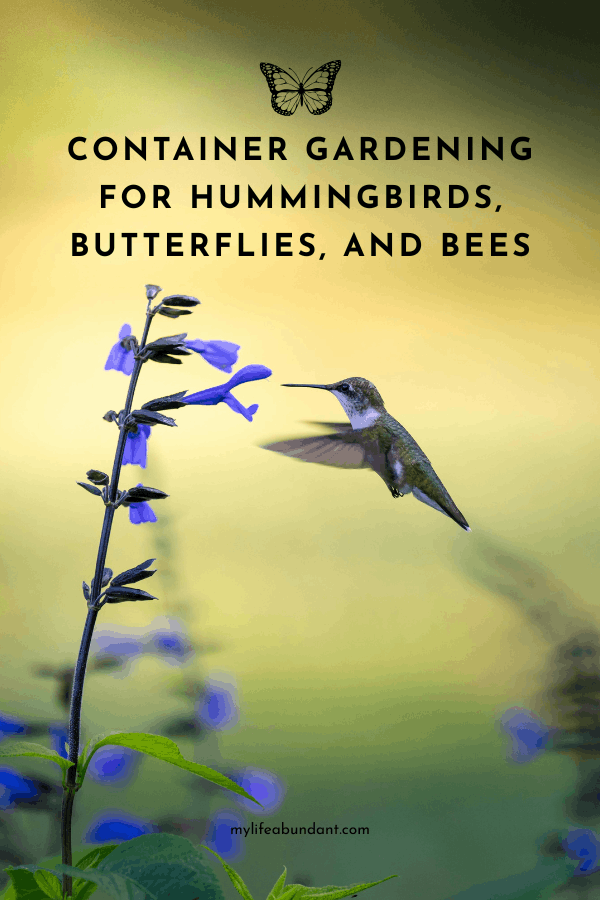
Container Gardening for Hummingbirds, Butterflies, and Bees
Thank you so much for visiting! This post may contain affiliate links that I receive commissions from purchases made. Click HERE for my disclosure statement.
a
Learn which annuals and perennials to grow in containers to attract hummingbirds, butterflies, and bees to your porch or patio, with a free printable plant guide included!
If you’ve ever stood on your porch or in your yard watching a hummingbird hover over a flower and thought, I want more of that, container gardening is honestly one of the easiest ways to make it happen. You don’t need a big yard or an elaborate garden bed. A few well-chosen pots, the right plants, and a sunny spot are all it takes to turn your garden, patio, balcony, or front steps into a little pollinator paradise.
I’ve been experimenting with this for a few years now, and what I love most is how flexible it is. You can move things around, swap out plants that aren’t performing, and completely change the look from one season to the next. For those of us here in Central Florida, it’s also a good way to work around our weird two-season growing situation, where summers are brutal, and winters are mild enough to keep things going when the rest of the country is buried in snow.
Let me walk you through the plants I’ve had the best luck with, broken down into annuals and perennials, so you know what you’re dealing with in terms of commitment and replanting.
Why Containers Work So Well for Pollinators
The biggest thing containers have going for them is control. You can fine-tune the soil, adjust drainage, and cluster pots together to create a concentrated patch of color and nectar that’s hard for hummingbirds and butterflies to miss. The “cluster pots” method is what works well for me since I have a very small yard. Pollinators are visual creatures, so a grouping of containers is actually more effective than scattered plants in a big bed, because it creates a landing zone they can spot from a distance.
You also get to place things strategically. I have a hummingbird feeder with the planting containers nearby to help them discover the real food source. Once they figure that out, they hang around a lot longer.

Annuals to Plant in Containers
Annuals are plants that complete their whole life cycle in one growing season, so you’ll be replanting each year. The upside is that they tend to bloom heavily and for a long time, which is exactly what you want for pollinators.
Salvia might just be the MVP of the hummingbird container garden, and the good news is there are several varieties worth growing, each with its own personality. Red salvia is the classic go-to because hummingbirds are hardwired to seek out red, and it delivers all season long. Blue salvia is a slightly different look, with tall spikes of violet-blue flowers that attract both hummingbirds and bees. It has a more refined, airy appearance than red salvia and looks beautiful mixed in a container with warmer-colored plants. Both are sold as annuals here in Florida, though blue salvia sometimes survives a mild winter and comes back. Bees work all three of these salvias heavily, so they’re pulling double duty in your pollinator garden.
Firecracker plant (Russelia equisetiformis) is one of those plants that just looks like it was designed with hummingbirds in mind. The long, arching stems are covered in tiny tubular red and orange flowers that bloom nearly year-round in our climate, and hummingbirds find it irresistible. It has a weeping, fountain-like shape that looks especially striking in a tall container or a raised planter where the stems can spill over the sides. It can handle heat, drought, and neglect once established, which makes it pretty forgiving for busy gardeners. This plant can get rather large and does really well in the ground.
Lantana is probably the single best annual you can grow in a Florida container for attracting butterflies. Gulf fritillaries absolutely mob it, and I’ve seen painted ladies, zebra longwings, and skippers on it too. It comes in a wide range of colors and handles heat and drought like a champ once it’s established. It also blooms almost continuously from spring through fall, which gives you a very long window. Just know that it’s toxic to pets if ingested, so keep that in mind if you have animals on the porch. When looking for lantana, make sure you get the native variety, and some lantanas are invasive.
Pentas is another Florida staple. It’s a butterfly magnet, especially for swallowtails and monarchs, and it works beautifully in containers because it stays relatively compact. The star-shaped flowers come in red, pink, white, and lavender. Hummingbirds visit it too, though they tend to prefer tubular flowers. It loves full sun, and our heat doesn’t faze it at all.
Zinnias are workhorses. They’re cheap, they’re easy to grow, really well from seed, they come in almost every color, and butterflies land on them constantly. If you’re trying to attract monarchs, plant orange and red zinnias. I’ve had great luck starting them directly in containers in early spring here in Central Florida.
Cuphea (cigar plant) is one that I think is underrated and my favorite tubular. The little tubular orange and red flowers look like tiny cigars, and hummingbirds go absolutely crazy for them. It’s sold as an annual here even though it can sometimes survive our mild winters. Either way, it’s worth planting every year.
Impatiens don’t attract butterflies much, but pollinators and hummingbirds do visit them, and they’re one of the few options that work in shadier spots. If your porch or balcony doesn’t get full sun, impatiens can fill that gap while still offering some pollinator value.
Perennials to Plant in Containers
Perennials come back year after year, so the investment pays off over time. In Central Florida, we have an advantage because our winters are mild enough that many perennials that would die up north just keep on going for us.
Firebush (Hamelia patens) is a Florida native and one of the most reliable hummingbird plants you can grow here. The tubular orange-red flowers bloom from spring through fall, and the plant can get large, so give it a big container or plant it in the yard. It’s a shrub, really, so over time you’ll have a substantial plant. Butterflies visit it too, especially zebra longwings.
Black and blue salvia deserves its own spotlight because it’s genuinely one of the most spectacular hummingbird plants I’ve ever grown. The flowers are a deep, rich cobalt blue, almost black, and the color combination is just stunning. Hummingbirds are absolutely wild for it, probably because those tubular flowers are perfectly shaped for their beaks. It can get tall, so it works well as the centerpiece of a large container grouping. It dies back a bit in winter here, but comes back reliably, which makes it one of the better perennial investments for a Florida porch garden. One of my favs.
Blanket flower is a fantastic addition if bees are a priority for you. The bold, daisy-like blooms in fiery shades of red, orange, and yellow are basically a beacon for native bees and honeybees alike, and the flowers keep coming all season if you deadhead them regularly. It also attracts some butterflies. In containers, look for the more compact cultivars like ‘Arizona Sun’ or ‘Spintop’ so it doesn’t outgrow its pot too quickly. Full sun and good drainage are non-negotiable for blanket flower, but those are pretty easy conditions to control in a container. It divides well to replant in different places or pots.
Porterweed is another Florida native perennial that pollinators adore. The tiny purple or blue flowers along its spiked stems aren’t showy, but butterflies, especially zebra longwings and monarchs, love them. It spreads and seeds around freely, so in the ground, it can become weedy, but in a container, you keep it totally in check. There is also a red version of Porterweed.
Blue daze is a low-growing perennial groundcover that works beautifully as a trailing edge plant in containers. The tiny blue flowers attract bees and small butterflies. It loves heat and sun and pretty much takes care of itself once established.
Plumbago is another Florida favorite. The pale true-blue flowers bloom from spring through fall and attract butterflies, especially the Cassius blue. It’s technically a shrub but stays manageable in a large container and gives you a soft, cottage-garden look. I have had this plant in the ground for many years now because it’s a prolific grower. You can trim it hard all summer, and the cold doesn’t faze it.
Tips for Putting It All Together
The picture above is what my little hummingbird, butterfly, and bee flower garden looks like. The vincas in the front came up on their own from the seed droppings from last year. Black and blue salvia, red salvia, firecracker plant, and blue salvia are all tubular plants. The hummers really enjoy the firecracker plant.
For hummingbirds specifically, tubular red or orange flowers are your best bet. They navigate by color first, so red salvia, firebush, firecracker plant, and cuphea will get their attention fastest. Once they know your pots have food, they’ll start exploring everything else, including the black and blue salvia, which they tend to discover a little later but then visit obsessively.
For butterflies, you want flat or clustered flowers they can land on easily, like lantana, zinnias, and pentas. Butterflies can’t hover the way hummingbirds do, so they need a surface to land on.
For bees, particularly native bees, blue, purple, and yellow flowers are where it’s at. Blanket flower, the black and blue salvia, porterweed, and plumbago are all great for this. Native bees are often smaller and less aggressive than honey bees, and they’re incredibly important pollinators for your vegetable garden. I often trim or deadhead flowers, and the bees never bother me. They have a job to do.
When it comes to container size, go bigger than you think you need. A 12-inch pot is really the minimum for most of these plants, and a 16-inch or larger pot gives you room to do a combination of plants together, like a tall black and blue salvia or firecracker plant in the center, pentas or zinnias in the middle, and calibrachoa or lantana trailing over the edges. I use a 20″ whiskey barrel or larger pot mainly so that I don’t have to water more. During the summer, Florida showers keep the pots watered well.
Skip the fancy soil mixes and just use a good quality potting mix with some slow-release fertilizer mixed in. Don’t use garden soil in containers since it compacts and doesn’t drain properly. Water consistently, because containers dry out fast in Florida, and once a plant wilts in the summer heat, it can take a while to recover. I add empty plastic soda bottles or chunks of styrofoam to the bottom of large pots, so I don’t have to use so much potting mix. I use Jack’s 20-20-20 when I plant new plants. That will help it get started. Later, I will use Jack’s 10-30-20 to get more blooms to help attract the pollinators.
One last thing: try to avoid pesticides, obviously, since you’re specifically trying to attract insects. If you get aphids or whiteflies, a spray of diluted dish soap and water handles most of them without harming the pollinators you’re trying to protect. Neem Oil is another good suggestion since it is natural.
Once you get a few containers going, it kind of snowballs. You start noticing which plants the hummingbirds hit first thing in the morning, which ones the butterflies prefer in the afternoon heat, and pretty soon you’re planning your whole area around it. It’s one of those things that just makes sitting outside a lot more fun.
Have you tried any of these plants before? I’d love to hear what’s been working in your garden. Drop a comment below and let me know!
I love my little rain gauge so I can see from the window how much rain we have gotten. It’s a little whimsy, but I love how it looks. My hummingbird feeder has been with me for a few years and has a vintage look. I make my own syrup with 3 cups of hot water and 1 cup of sugar. It stores well in the fridge. I finally found a small bird bath that the squirrels don’t care about. The top screws off, so it’s very easy to clean.
Free container plants for pollinators Printable
Looking for a printable to reference plants for your pollinator garden?
This is an 8.5 x 11 printable to print and frame at home using heavyweight cardstock. Or send it to your favorite printer for no-worry printing. I prefer this method for a more true color printing.
Click on the button below to download the print to your computer.
Garden Inspiration
My Garden Favs
Check out my favorite garden supplies essential for anyone growing beautiful plants.
The Ultimate Garden Planner
Make your garden the best it can be
It’s time to plan that dream garden with our digital garden planner, and the printables feature a range of topics, including planning, planting, growing, and maintaining your garden.
subscribe
Sign up for our newsletter to receive recipes, gardening tips, decor ideas, travel, vintage galore, and more inspiration!
And don’t worry, we hate spam too! You can unsubscribe at any time, and your information will *never* be shared or sold to a 3rd party. Privacy Policy
Shop my Amazon Storefront, my LTK sources, my favorite finds, and garden supplies. If you have a fur baby, check out some of Dixie’s favorite items. When you purchase through one of my links, I earn a small commission, which helps me continue sharing the content you expect on my blog.
Tammy
I’m a country girl living my geeky boomer life, while figuring out widowhood. Between digging in the dirt, my camera, thrifting finds, and cooking, I’m a child of God walking this next chapter with Him leading the way.
Read more about me and check out my media kit. Our Privacy Policy
This is very helpful Tammy, thank you so much. I’ve always loved to turn my garden into a safe haven for bees and butterflies but I had no idea how to go about it or what to plant. The list of perennials and annuals is very helpful.
I think everyone should have a safe place or haven for birds and bees, especially bees, as they need to be protected.
Lucy | http://www.lucymary.co.uk
Ooh. I love this! I already container garden for veggies, I’m going to add a few more for these.
I am so going to make a container garden to attract hummingbirds and bees and butterflies too! I love this idea and have a really cool hydrangea bush… that has cone shaped white flower clusters and last year I saw the most gorgeous bright green hummingbird that came to hit the flowers for a bit. It was magical!
Growing up, I loved watching hummingbirds at my parents’ feeder. Planting flowers in our backyard feels like a win-win…it will look beautiful and naturally bring the hummingbirds back!
Container gardening For hummingbirds, butterflies And bees is a pretty new concept for me. Thank you very much for these practical tips.
I do think that helping the creatures survive is such an important thing! I absolutely love the bees and have bee houses out around my garden.
Much of my gardening the past few years has been in containers and I love it! Wish I had caught onto it a long time ago. I am down to one traditional flower garden. Everything else is potted. One thing that helped me make the switch with success was when I discovered that added small stones to the top of the soil in the pot keeps squirrels and chipmunks OUT of my planters! Works beautifully.
Thanks for sharing this. I love seeing all the butterflies and bees in my garden. I would love it if you could join me for this month’s Sharing Serenity link party at https://serenityyou.com/sharing-serenity-link-party-july-2026/